Malibu Beach: 3-Year Market Projection
1. Active Listings & Closed Sales
- Active Listings: Expected to remain elevated, hovering 210–230 annually, as sellers continue to test the market.
- Closed Sales: Likely to stay weak, 25–45 closings per year, given sharp declines in absorption.
Projection:
- 2026 → ~220 listings | ~35 sales | 15.9% closure rate
- 2027 → ~225 listings | ~40 sales | 17.8% closure rate
- 2028 → ~230 listings | ~45 sales | 19.6% closure rate
2. Closure Rate (Absorption)
- 2021–2022 highs (40–52%) are unlikely to return soon.
- Market will likely stabilize in the 15–20% absorption range, reflective of thin but steady ultra-luxury activity.
3. Pricing Trends
- Median List Price projected to hold $12M–$13.5M, as sellers anchor to pandemic-era highs.
- Median Sold Price expected to track slightly lower, $11M–$12.5M, reflecting buyer leverage.
- Wide negotiation gaps will persist, but trophy homes will command premiums.
4. Total Sold Volume
- With fewer closings, annual volume will remain muted compared to peaks.
- Expect $350M–$500M annually, well below the $800M+ highs of 2021–2022.
Projection:
- 2026 → ~$375M
- 2027 → ~$425M
- 2028 → ~$480M
5. Value Per Square Foot
- Stabilization around $3,200–$3,500/Sq.Ft., down from 2022’s record $3,874 but still ~50% above pre-2016 averages.
6. Sale-to-List Ratios
- Likely to remain in the 84–88% range, showing buyers retain strong leverage in negotiations.
Bottom Line
Malibu Beach is entering a low-volume, high-price equilibrium:
- Trophy estates will continue to transact at strong $/Sq.Ft. values.
- However, overall liquidity remains limited, with fewer than 1 in 5 listings closing.
- Investors should expect longer hold times and selective buyer pools, but continued price resilience supported by limited coastal supply and global demand.
Download Malibu Beach Data
Analysis of Malibu Beach (2013–2025)
1. Market Activity: Active Listings & Closed Sales
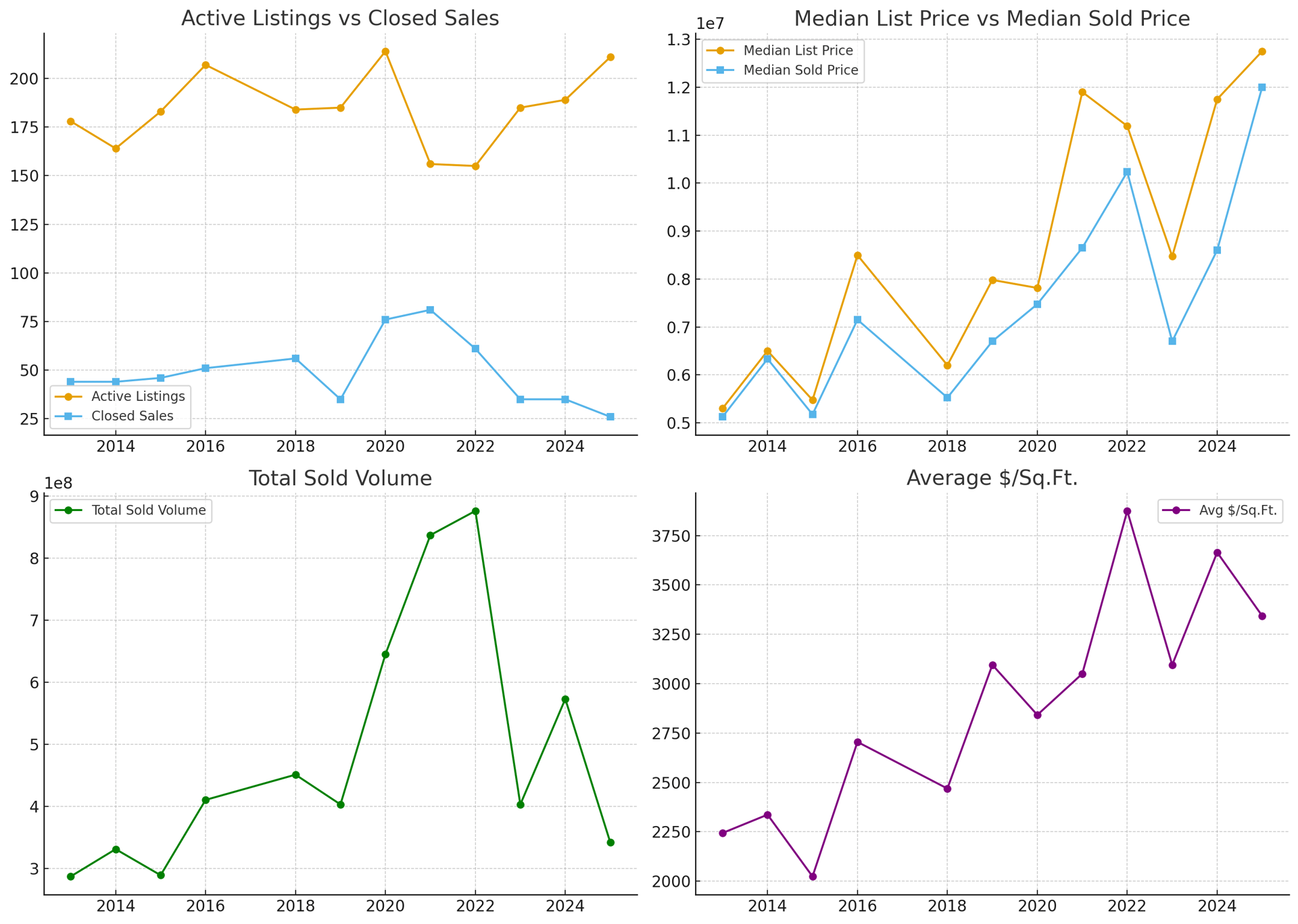
- Active Listings fluctuated between 156–214, peaking in 2020 (214) and 2025 (211).
- Closed Sales were consistently low relative to listings, ranging 26–81 annually.
- The strongest absorption was in 2021 (51.9% closure rate), when 81 homes closed.
- By 2025, closure rate collapsed to 12.3%, signaling severe demand weakness — fewer than 1 in 8 listings closed.
2. Closure Rate (Absorption)
- 2013–2016: Weak but stable absorption (~24–26%), with 44–51 closings per year.
- 2018–2020: Improved liquidity, peaking at 35.5% in 2020 as buyers sought trophy assets.
- 2021–2022: Historic highs — closure rate surged to 51.9% in 2021 and 39.4% in 2022.
- 2023–2025: Sharp deterioration — closure rate fell to 18.9% (2023), 18.5% (2024), and 12.3% (2025).
3. Pricing Trends: Median List vs. Median Sold
- 2013–2015: Median prices held in the $5M–$6.5M range.
- 2016: A spike — median list reached $8.5M, but sold median only $7.1M, showing buyer resistance.
- 2020–2022: Major appreciation — list medians reached $11.9M in 2021, and sold medians peaked at $10.2M in 2022.
- 2023–2025: Correction — by 2025, sold median rebounded to $12M, but with very few transactions, signaling only ultra-luxury deals closing.
4. Total Sold Volume
- 2013–2016: Steady annual volumes of ~$287M–$410M.
- 2018–2020: Expanded volumes, reaching $645M in 2020.
- 2021–2022: Historic peak — $837M in 2021 and $876M in 2022.
- 2023–2025: Volume collapsed — down to $403M in 2023, $573M in 2024, and only $342M in 2025, the weakest in over a decade.
5. Value Per Square Foot
- 2013–2016: Averaged ~$2,200–$2,700/Sq.Ft.
- 2018–2020: Climbed steadily, peaking near $3,100/Sq.Ft. in 2019–2020.
- 2021–2022: Record highs — $3,874/Sq.Ft. in 2022, fueled by bidding wars.
- 2023–2025: Correction phase — dropped to $3,095/Sq.Ft. (2023), stabilized around $3,300–$3,600/Sq.Ft. (2024–2025).
6. Sale-to-List Ratios
- 2013–2015: Discount-heavy, ratios in the 88–91% range.
- 2016–2022: Tightened to 92–96%, showing buyers paid near ask.
- 2021–2022: Strongest market, ~92–92.4% close to ask despite higher pricing.
- 2023–2025: Softening — 83.5% in 2025, the weakest, with sellers forced into steep discounts to close deals.
What This Means
- 2013–2016: Stable but soft market with modest sales and high time on market.
- 2017–2020: Acceleration in trophy home demand, culminating in pandemic-era flight-to-luxury (2020 surge).
- 2021–2022: Golden years — record absorption, volumes, and $/Sq.Ft. set Malibu Beach apart as one of the hottest coastal enclaves worldwide.
- 2023–2025: Sharp contraction — sales plunged, absorption collapsed, and discounts widened. Pricing remains high nominally, but liquidity has dried up.
Bottom Line
Malibu Beach has shifted from ultra-hot luxury liquidity (2021–22) to a thin, illiquid market (2023–25). Trophy homes can still fetch record $/Sq.Ft., but broader absorption is extremely weak.